
“Where are Coach bags made?” is a core question for many consumers when buying a Coach handbag. As a renowned American accessible luxury brand, Coach has long implemented a global manufacturing strategy. Its production facilities are distributed across multiple countries—primarily in Asia—while retaining a small portion of its production lines in the United States.
This article will break down the details of each manufacturing country to help you fully understand Coach’s production landscape.
1. Where do Coach bags come from?
Coach bags are not manufactured in a single country. Instead, the brand adopts a global production model. The core manufacturing hubs are concentrated in Asia, with a small amount of production kept in the U.S. All factories, regardless of location, must strictly adhere to Coach’s unified quality control standards.
1.1. Major Manufacturing Countries:
- Core producers: China, Vietnam, the Philippines, and India. These four countries are Coach’s primary production bases, handling the vast majority of global orders.
- Minor producers: The United States (mostly for high-end and limited-edition lines). Additionally, countries like Cambodia provide some auxiliary production capacity.
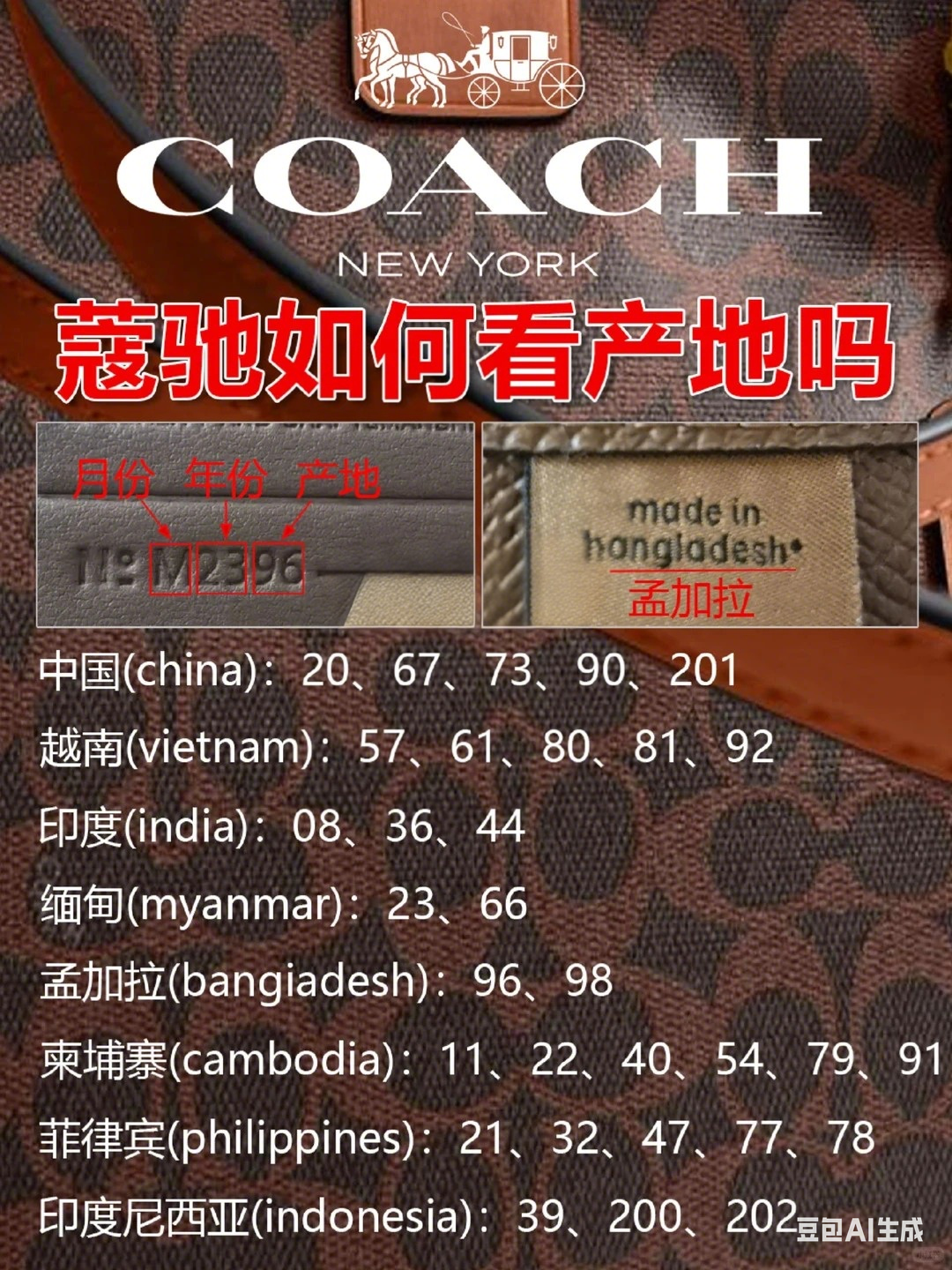
1.2. How to check the origin of your bag?
You can easily find out where your Coach bag was made by checking the internal tags. No special tools are needed. Here is how:
- Check the inner tag: Open the bag and look for a tag stamped with “Made in XXX” (e.g., China, Vietnam). This is usually located near the edge of an inner slip pocket or along the zipper.
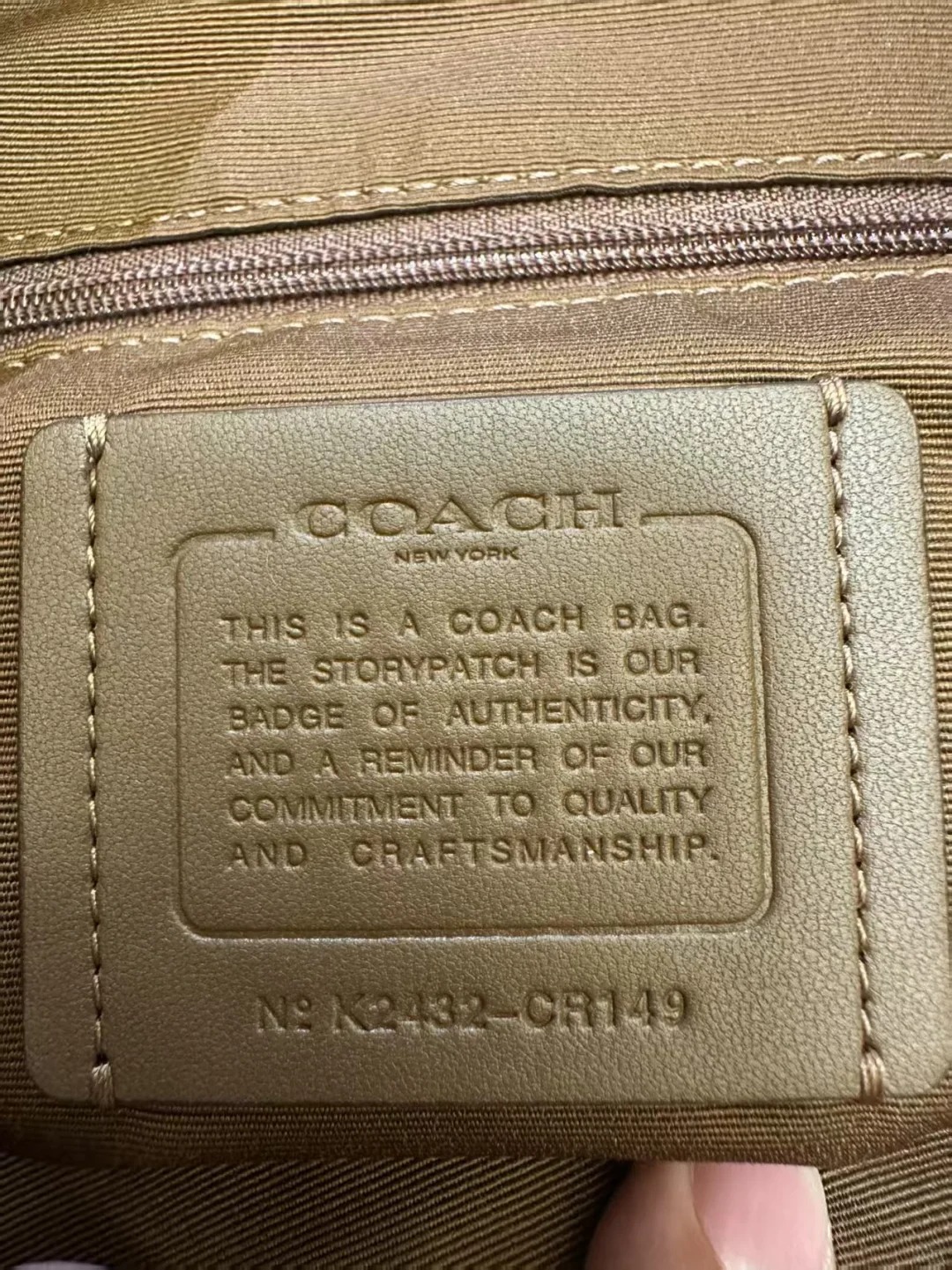
Identify the tag type: There are generally two types. The Creed Patch (the leather story patch, common in large bags before 2014 and after September 2016) and the small white style number tag (common in large bags from 2014 to August 2016 and most regular styles). The alphanumeric codes on these tags can also help identify the origin.
Pay attention to details: Authentic Coach origin tags are printed clearly with neat fonts. There is no blurring or ink fading. Fake bags often have incorrect origin tags (for example, marking “Made in Vietnam” on a style that was never produced there).
2. Are Coach bags made in China?
Yes. “Made in China” is one of the most important sources for Coach bags, holding a significant share of production for many years. Currently, a massive number of Coach bags are still manufactured in China.
2.1. Does “Made in China” affect the quality?
Absolutely not. Many consumers mistakenly believe that “Made in China” means poor quality, but this is a huge misconception.
All Coach factories in China must strictly follow the brand’s unified QC standards. From raw material sourcing and craftsmanship to final inspection, every step is heavily monitored. The quality is identical to bags made in other countries. In fact, Chinese factories have mature leather manufacturing techniques and decades of experience producing for luxury brands. Some Chinese-made Coach bags are highly sought after in the market specifically because of their exquisite craftsmanship.
2.2. Why choose to manufacture in China?
- Complete Supply Chain: China has a fully mature leather goods supply chain. From the supply of leather and hardware to cutting and sewing, everything is efficiently connected, reducing production costs and lead times.
- Labor Advantages: China has a vast pool of skilled leather workers who excel in stitching, polishing, and meeting Coach’s strict detailing requirements.
- Strong Production Capacity: The scale of Chinese factories is outstanding. They can quickly respond to global market demands, especially for the mass production of best-selling items, ensuring a stable supply.
3. Are Coach bags made in Vietnam?
Yes. Vietnam is one of Coach’s most important manufacturing countries. Its production share has been steadily increasing in recent years, making it the second-largest core base right after China.
3.1. Why are Coach bags produced in Vietnam?
- Cost Advantage: Labor costs in Vietnam are lower than in China. This effectively reduces Coach’s overall production costs while keeping product pricing competitive, which perfectly aligns with its accessible luxury positioning.
- Policy Support: The Vietnamese government offers numerous tax incentives for manufacturing, lowering the barrier to entry and the cost of setting up factories.
- Supply Chain Development: Vietnam’s leather manufacturing industry has grown rapidly, forming a solid production network that easily connects with raw material suppliers in neighboring countries.
- Diversification: Shifting part of the production to Vietnam helps Coach avoid over-reliance on a single country, mitigating geopolitical and trade barrier risks.
4. Are Coach bags made in the Philippines?
Yes. The Philippines is also a manufacturing country for Coach bags, primarily handling medium-volume production with a very stable output scale.
4.1. Why are Coach bags produced in the Philippines?
The core reason is highly cost-effective production capabilities that complement Coach’s global supply chain:
- Labor Cost Advantage: Labor costs in the Philippines are about 1/3 lower than in China. There is a large workforce with basic leather processing skills, which helps control costs.
- Quality Standard Compliance: Partner factories in the Philippines strictly follow Coach’s QC guidelines. The craftsmanship is mature, making it ideal for mid-volume, regular styles.
4.2. Key drivers for Philippine production:
- Supply Chain Diversion: As labor costs rise in China, Coach shifted some regular styles to the Philippines to relieve production pressure in a single region.
- Market Adaptability: Bags made here are mostly basic, regular styles aimed at the global mid-range market. The production cycle is short, offering a high cost-performance ratio to quickly meet market needs.
5. Are Coach bags made in India?
Yes. Coach has partner factories in India that primarily produce specific categories of bags and accessories. While the scale isn’t as large as China or Vietnam, it remains a vital part of their global supply chain.
5.1. What Coach bags are made in India?
Indian production mostly focuses on men’s bags and Small Leather Goods (SLGs):
- Men’s Bags: Men’s Warren pebbled leather tote, black leather backpack (F11250 QB/BK), blue leather sling bag (F11236 QB DEN), and the C9869 sling bag.
- Small Leather Goods: Classic scratch-resistant cardholders, keycases, coin purses, and select batches of women’s small wristlets.
- Note: The same style of Coach bag might be produced in different countries depending on the batch. Always refer to the inner tag.
5.2. Why are Coach bags produced in India?
- Raw Material Advantage: India has the largest cattle population in the world, accounting for 13% of global leather production. The leather is high quality and diverse, with many tanneries being LWG-certified, fulfilling Coach’s demand for premium, cost-effective materials.
- Labor Advantage: India has a rich labor force with a strong tradition of hand-sewing and intricate pattern-making, making it ideal for small-batch customizations and accessories.
- Market Layout: Manufacturing locally helps Coach supply the growing Indian and surrounding regional markets while diversifying global risk.
6. Are Coach bags made in the USA?
Yes, but the quantity is very small. U.S. manufacturing is limited to specific collections and is not the mainstream source. It mainly focuses on high-end, handcrafted items.
6.1. Why are Coach bags made in the USA?
The core reason is brand heritage and maintaining a high-end image:
- Brand Roots: Coach was founded in New York in 1941 as a family-run leather workshop. Handcrafted leather is the brand’s original DNA. Retaining a U.S. production line pays homage to its history.
- High-End Positioning: American-made Coach bags feature artisanal craftsmanship and premium materials. They target high-end consumers, differentiating themselves from mass-produced overseas styles.
6.2. Reasons for U.S. production:
- Craftsmanship Heritage: The U.S. retains traditional leather crafting techniques, perfect for limited editions that require finer details and a premium feel.
- Brand Premium: “Made in USA” carries a certain premium in the global market, attracting buyers who value brand history and top-tier quality.
- Local Demand: The U.S. is Coach’s core market. Producing locally caters to American aesthetics and shortens the supply chain for premium lines.
6.3. Comparison with Competitors:
- Coach: Retains a small U.S. production line for premium items but relies on Asia for the core volume. It perfectly balances heritage and accessible luxury.
- Michael Kors & Kate Spade: Almost zero U.S. production. They rely entirely on overseas mass production (China, Vietnam, etc.) to drive volume and affordability.
- High-End Luxury (Prada, Gucci): Core production is heavily monopolized in their home countries (Italy, France). Coach’s U.S. production sits somewhere in the “upper mid-range.”
6.4. “Made in USA” vs. “Made Overseas”
The core differences lie in positioning, craft, and price, not quality:
- Positioning: U.S.-made focuses on high-end, limited, handcrafted pieces. Overseas-made focuses on regular, mass-market, high-value pieces.
- Craftsmanship: U.S.-made leans toward handcrafting with longer production cycles. Overseas-made relies on standardized, highly efficient machine production. Both meet the exact same QC standards.
- Price: U.S.-made bags are typically 30% to 50% more expensive than similar overseas-made styles.
7. Conclusion
Coach’s manufacturing strategy is defined by a “global layout with multi-country specialization.” The core production countries are China, Vietnam, the Philippines, and India, while the U.S. produces a fraction of high-end handcrafted pieces. There is no such thing as “bags from one country are fake” or “bags from one country are better quality.”
No matter where a Coach bag is born, it must pass the brand’s rigorous quality control. The origin merely reflects differences in market positioning, crafting methods, and price.
When buying, don’t overthink the origin country. Focus on authenticating the inner tag, stitching, and serial number. If you want a premium artisanal feel, go for “Made in USA.” If you want everyday accessible luxury, the standard overseas-made bags are your perfect choice.





Comments0